

Emily Bird, Head of Science at an inner‑city Manchester secondary school, shares her practical and effective ways to encourage meaningful revision in A‑level science. Drawing on real classroom experience, she explored strategies that build confidence, deepen understanding, and help students revise with purpose rather than pressure.
Why independent learning matters
Independent learning is a key part of success at A-level and beyond. As well as achieving good grades, students need to develop the study habits, resilience and self-management skills they’ll use at university, in apprenticeships and in the workplace.
Our role is to help students become increasingly independent by teaching them how to learn effectively, not just what to learn.
What does independent learning look like?
Independent learners can:
- Organise their own study.
- Identify what they know and what they need to improve.
- Choose effective revision strategies.
- Reflect on their progress and adapt their approach.
These skills develop over time and need to be explicitly taught.
Common barriers
Students don’t all arrive with the same experience of independent study. Some may:
- Rely on GCSE revision methods that no longer work.
- Struggle to identify gaps in their knowledge.
- Feel overwhelmed by the increased demands of A-level.
- Lack confidence or motivation.
Recognising these barriers early helps us provide the right support.
What the research tells us
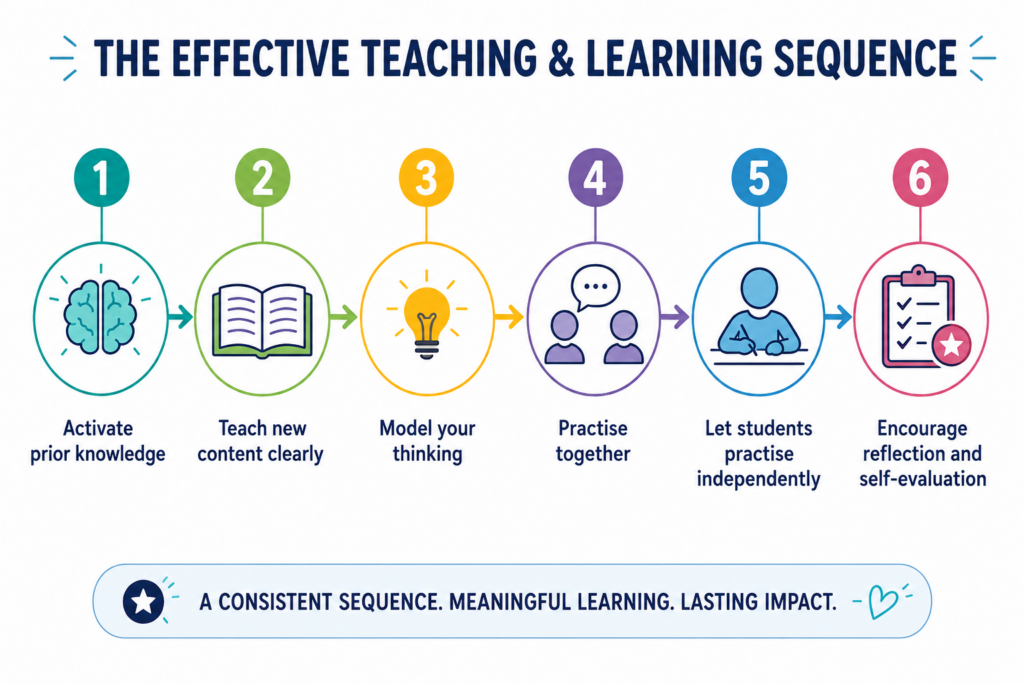
Evidence from the Education Endowment Foundation* (EEF) shows that students become more independent when teachers gradually reduce support.
A simple sequence is:
- Activate prior knowledge.
- Teach new content clearly.
- Model your thinking.
- Practise together.
- Let students practise independently.
- Encourage reflection and self-evaluation.
With all that being said, here are 5 ways to enable students to study effectively and independently:
1. Set clear expectations
Students should understand that learning doesn’t stop when the lesson ends. A useful guide is that students should aim to complete around one hour of independent study for every hour spent in lessons, alongside homework. Consistency across subjects helps students develop positive study habits.
2. Teach students how to revise
We shouldn’t assume students know how to revise effectively. Model strategies in lessons by explaining:
- why they work;
- how you approach exam questions;
- how to spot and address knowledge gaps.
3. Focus on what works
Some popular revision techniques, such as highlighting or repeatedly reading notes, feel productive but have little impact on long-term learning. Instead, encourage strategies with the strongest evidence, including:
 A simple revision cycle works well: Retrieve what you know. Review what you don’t. Apply it using exam questions.
4. Keep students accountable
Independent learning is more likely to happen when it’s valued. Regular check-ins, study logs, tutor conversations and recognising consistent effort all help students stay on track.
5. Support those who need it
Some students will need additional support due to confidence, organisation, SEND, work commitments or other barriers. Simple interventions such as revision planning, supervised study, peer mentoring and targeted support sessions can make a significant difference.
Educake supports thousands of students with independent learning when it comes to A-level science, you can find out more here.
*link to EEF model https://d2tic4wvo1iusb.cloudfront.net/production/eef-guidance-reports/metacognition/metacognition-seven-step-model_practitioner-tool_v.2.0.0.pdf