
By Constance Young, Head of Editorial at Educake
The current curriculum change has made us reflect on the last curriculum change. I remember the varied reactions to the withdrawal of the single core science GCSE in 2016: some bemoaned the lack of a suitable pathway for SEND students, lower performing students, or students with little interest in science. Some were eager to see a higher volume of science content as default. Others were grateful for fewer science pathways for teachers to juggle.
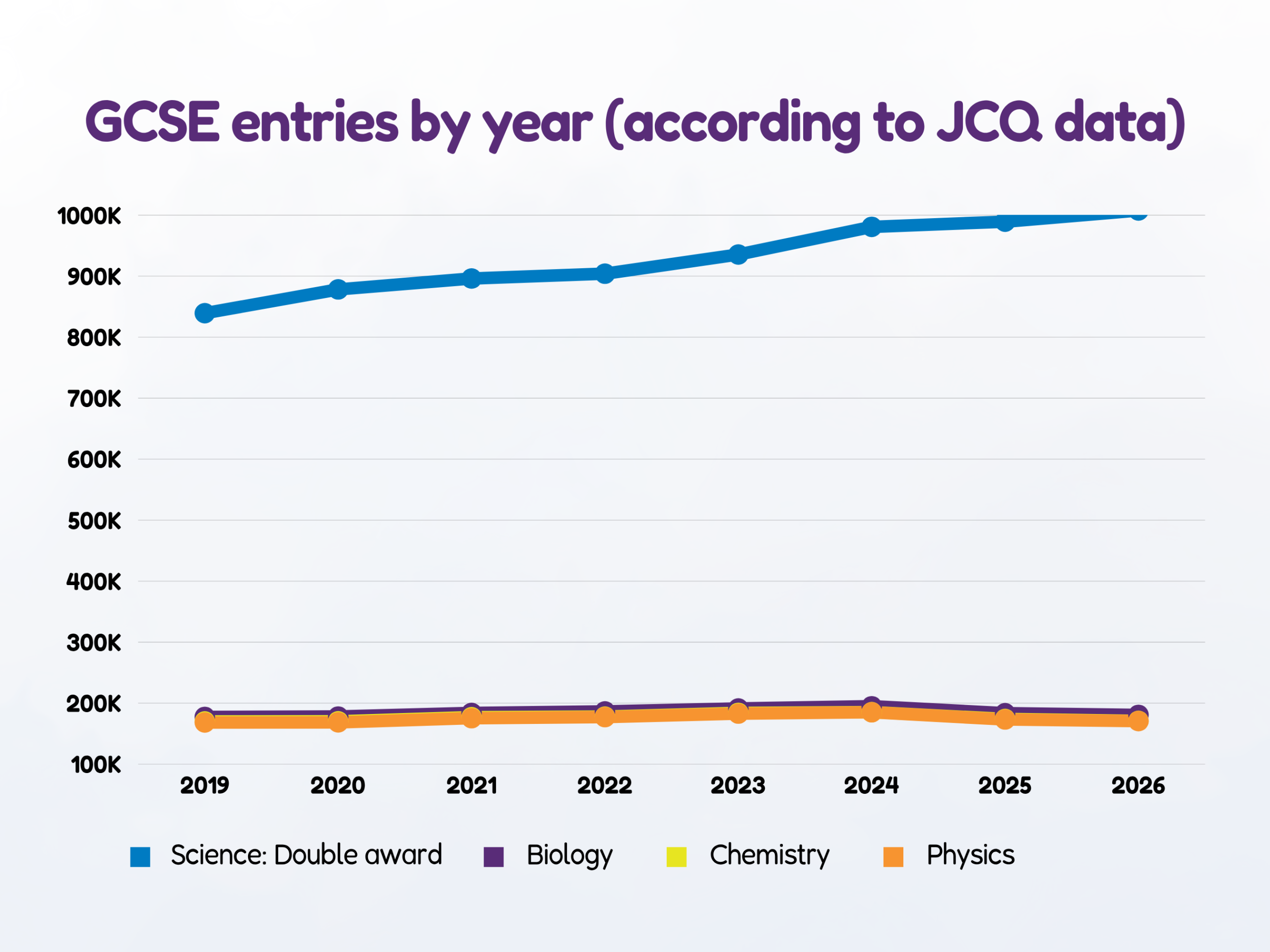
Over the first few years of the new 2016 curriculum, science entries shifted between courses as both schools and students adjusted to the lack of core science, as well as the new Ebacc and Progress 8 measures. Since then, we’ve seen a steady increase in Combined Science entries, while the separate sciences remain flat or see a modest decrease.
GCSE entries by year (according to JCQ data)
Results comparisons show that Triple Science students score higher than those who sit the Combined Science (double award). STEM Learning reports that “These results show what we already know, that triple science is targeted at high-attaining young people in schools and not all young people get the opportunity to take the separate sciences.” The gap is likely a combination of science-enthused students choosing Triple Science, schools steering higher attainers towards it, or schools discouraging students who struggle in science or maths from it.
Whatever the causes, Triple Science has solidly earned itself the reputation among students, parents, and industry, including potential future employers, as the harder or more academic option for higher attainers smarter students. Teachers have reported issues tackling these preconceptions during GCSE selections. There is a tension between where the school believes the student can achieve the best outcomes, what families perceive as the pathways to success, and what the student is interested in.
Teacher Tapp provides an interesting look at what Triple Science provision in schools actually looks like.
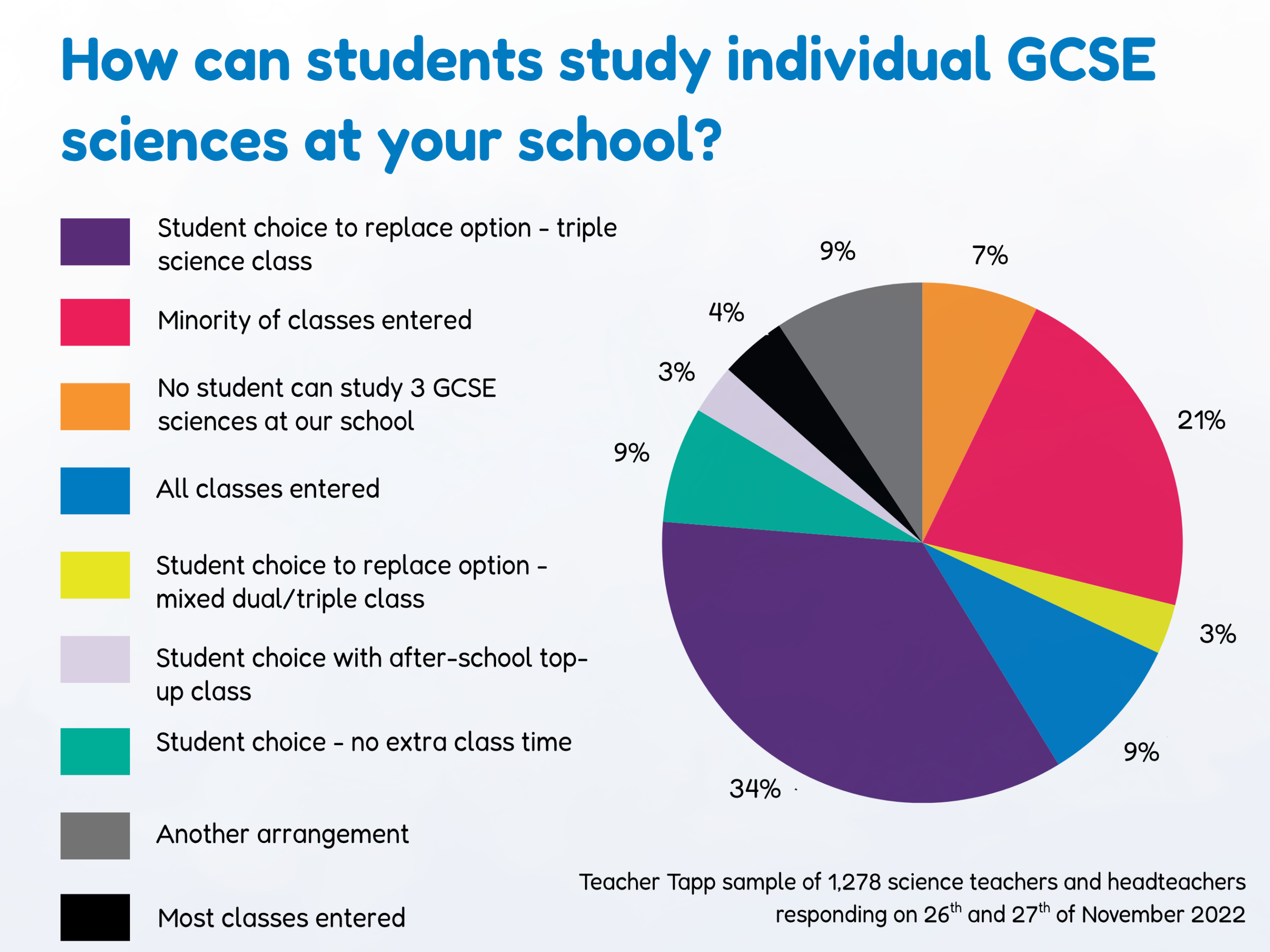
While 9 % of teachers reported that all students are automatically entered for Triple Science, 7% reported that Triple Science isn’t offered at their school. For many schools the decision to take Triple is up to the student but there may be limitations set by the school.
As Francis’ Curriculum and Assessment Review states, “Students who take Triple Science, rather than Combined Science, are significantly more likely to study Science subjects at A Level and degree level” and have more direct access to well-paid STEM careers. A Triple Science entitlement sounds like a rational step to ensure that students’ options aren’t limited and they aren’t prevented from exceeding predicted capabilities. In 2006, the government announced that by 2008, all Key Stage 3 students who achieved at least a 6 on their science SATs should be entitled to take Triple Science. The idea of an entitlement and the perception of Triple as the academic pathway for high performers are not new.
Equity in choice to study Triple Science does not guarantee the equity of provision. School leaders describe a complex landscape around Triple Science enrollment. At the 2026 Association for Science Education (ASE) conference, a session reviewing CAR heard significant audience feedback that the entitlement may not be in the best interest of students or schools if it cannot be practically realised. It could end up being an ambitious and admirable aim, scuppered by the specifics.
Staffing, timetabling and costs
The CAR acknowledged the barriers to their recommendation, to which the government responded that they “will work with schools to understand the barriers to entry for triple science, including workforce challenges, and support schools to develop a triple science offer”. However, for several years the recruitment of specialist teachers has failed to meet targets. How will new efforts differ to be successful? The lack of specialists often leads to teaching outside specialism, which can risk the quality of the provision.
Timetabling Triple Science into the slot intended for only two GCSEs of content is likely to see a reduction in practical work and depth, as well as a decrease in student outcomes. Students with more support outside of school, such as independent tutoring, may get by, while those without will struggle. A situation which will only stick a crowbar into the disadvantage gap and pry it wide rather than closing it.
There are cash costs too, including additional exam entry fees and eight more practicals to resource and deliver.
Breadth and access to A-level
If Triple Science is scheduled to take up a GCSE option slot, are we limiting the wealth of subjects students can study at KS4 and potentially damaging other subjects, like the arts, that are often squeezed out in the name of academic rigour?
Triple Science is often seen as a stronger foundation for A-level science. However, A-level science entry should be possible for Combined Science students. A Cambridge University Press & Assessment report covering 2021–2023 showed that students who achieved a top score in Combined had a 25% chance of a top score in A-level. A top score in a GCSE separate had a 45-47% chance of a top score in the related A-level. Could a single pathway through Key Stage 4 level the playing field for both A-level entries and outcomes?
Many bodies, including The Royal Society, the Royal Society of Chemistry, and the Association for Science Education, have backed a single pathway through science as the most equitable option. The ASE asserts that “The dual route through GCSE sciences […] exacerbates social inequalities and hinders progression to further study of science post-16 for many young people. The ASE believes that a single route for the sciences at GCSE would offer more equitable access to all, open up options for more young people to study a broad 14-16 curriculum”.
While the Triple Science entitlement has a commendable aim, there is a real concern that the pressures on schools, and the contexts students face outside of school will not allow this entitlement to realise its goal. Would a single route through science, written to enable progression to KS5, be more equitable? Can the government provide compelling evidence for why a Triple Science solution is better than a single pathway?
If we overcome the barrier of equality of access to triple science, how do we get to a place of equality of provision? Without sufficient support and direction nationally, it will fall to schools and trusts to figure out how to deliver a Triple Science entitlement despite the barriers and we may end up with a similar situation to what we have presently.
References
- JCQ. GCSE results in the UK (2019-2026). https://www.jcq.org.uk/gcse-interactive-results-dashboard/
- Calvert, Elizabeth (2026). “GCSE science entries: what do this year’s trends tell us about access to triple science?” Stem Learning. https://www.stem.org.uk/all-news/gcse-science-entries-what-do-this-years-trends-tell-us-about-access-to-triple-science
- Teacher Tapp (2022). “Triple science teaching arrangements in schools.” https://teachertapp.com/articles/triple-science-teaching-arrangements-in-schools/ .
- Curriculum and Assessment Review (2025). “Building a world-class curriculum for all: Final Report.” p. 115. https://assets.publishing.service.gov.uk/media/690b96bbc22e4ed8b051854d/Curriculum_and_Assessment_Review_final_report_-_Building_a_world-class_curriculum_for_all.pdf
- House of Lords – Science and Technology committee. (2006). “Science Teaching in Schools.” https://publications.parliament.uk/pa/ld200506/ldselect/ldsctech/257/257.pdf
- UK Government. (2025). “Government response to the Curriculum and Assessment Review.” p.37. https://assets.publishing.service.gov.uk/media/690b96bbc22e4ed8b051854d/Curriculum_and_Assessment_Review_final_report_-_Building_a_world-class_curriculum_for_all.pdf
- Worth, Jack (2025). “A widespread lack of specialist physics teachers persists due to recruitment and retention challenges”. National Foundation for Education Research. https://www.nfer.ac.uk/blogs/a-widespread-lack-of-specialist-physics-teachers-persists-due-to-recruitment-and-retention-challenges/
- Gill, T. (2025). “Progression from GCSE to A level, 2021 – 2023.” (Statistics Report Series No. 144). Cambridge University Press & Assessment. https://www.cambridgeassessment.org.uk/Images/735630-144.-progression-from-gcse-to-a-level-2021-2023.pdf
- The Royal Society (2024). “The Royal Society’s response to the Curriculum and Assessment Review call for evidence.” p. 29. https://royalsociety.org/-/media/policy/publications/2024/2024-11-22-curriculum-assessment-response.pdf
- Association for Science Education (2025). “ASE POLICY PERSPECTIVESAn Equitable Route through the Sciences at GCSE.” https://www.ase.org.uk/sites/default/files/ASE%20POLICY%20PERSPECTIVES%20-%20Equitable%20Routes.pdf